
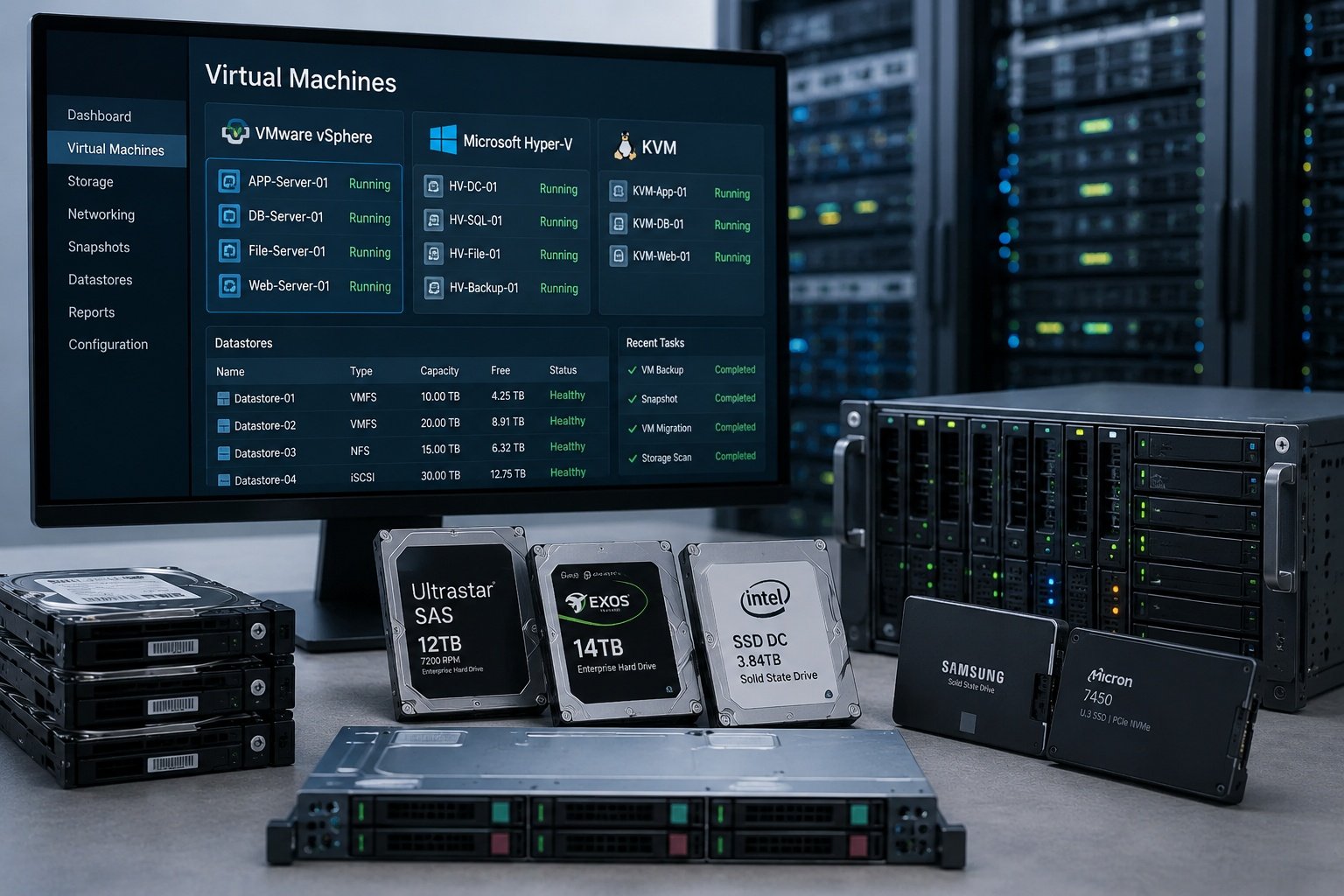
virtual machine data recovery in san jose & the bay area
VMware, Hyper-V, KVM, VMDK, VHDX, datastore & snapshot recovery
Virtual machines, databases, applications, business files, virtual disks, snapshots, and guest operating systems may still be recoverable when a VM will not boot, a datastore becomes inaccessible, snapshots are damaged, virtual disks are corrupted, or the underlying RAID, server, SAN, NAS, or storage system fails.
With 26+ years of data recovery experience, Kotar Data Recovery provides professional virtual machine recovery for businesses, IT teams, developers, engineering organizations, and professionals in San Jose and across the Bay Area. We recover data from VMware, Hyper-V, KVM, QEMU, Xen, VirtualBox, VMDK, VHD, VHDX, QCOW2, RAW, VMFS, and other supported virtualized storage environments.
Free secure courier pickup is available across the Bay Area. You can also request a free shipping label or visit our San Jose lab by appointment.
The available storage or system components are examined within 2 hours after they arrive at our San Jose lab, and we provide the recovery options and a fixed quote before any work begins.
why virtual machine data can still be recoverable
Virtual machines depend on multiple layers of storage, including physical drives, RAID arrays, datastores, virtual disks, snapshots, file systems, and guest operating systems. A failure at one layer can make the entire VM appear inaccessible even when recoverable data remains elsewhere in the storage structure.
Virtual machine data may become inaccessible after datastore corruption, damaged virtual disks, deleted snapshots, broken snapshot chains, RAID failure, failed backups, accidental deletion, storage reconfiguration, or underlying disk problems.
Our San Jose lab evaluates the storage hierarchy first, protects the original source media, and uses the safest available recovery method to reconstruct virtual disks, datastores, guest file systems, and accessible application data.
supported virtualization platforms
VMware environments including ESXi, vSphere, VMFS, vSAN, VVols, VMware Fusion, and VMware Workstation
Microsoft Hyper-V environments using VHD, VHDX, AVHDX, checkpoints, virtual disks, and Windows-based host storage
Linux KVM and QEMU systems using QCOW2, RAW, Linux file systems, and virtualized server storage
Citrix Xen environments including XenServer, XVA, and VHD-based virtual machines
Oracle and VirtualBox environments using supported virtual disks, snapshots, host storage, and guest file systems
Virtualized business systems hosted on RAID arrays, SAN storage, NAS systems, local server storage, SSD arrays, and enterprise infrastructure
virtual disk and storage formats we recover
VMDK virtual disks used by VMware ESXi, vSphere, Fusion, and Workstation environments
VHD and VHDX virtual disks used in Microsoft Hyper-V and Windows virtualization
AVHDX checkpoint files associated with Hyper-V snapshot and checkpoint chains
QCOW2 and RAW virtual disks used in KVM, QEMU, and Linux virtualization environments
VMFS datastores containing VMware virtual machines, configuration files, snapshots, and virtual disks
SAN and NAS-backed datastores supporting shared virtualized infrastructure and business systems
RAID-backed virtualization storage affected by degraded arrays, failed rebuilds, multiple drive failures, or controller problems
Guest file systems including NTFS, ReFS, EXT4, XFS, Btrfs, APFS, and other supported file-system structures
common virtual machine failures we recover from
Virtual machine will not boot because of damaged virtual disks, guest file-system corruption, missing snapshots, or underlying storage failure
Corrupted VMDK, VHD, or VHDX files causing missing disks, unreadable data, or VM startup failure
Inaccessible datastore after file-system corruption, storage failure, RAID problems, or interrupted maintenance
Deleted virtual machine where VM configuration files, virtual disks, snapshots, or guest data were removed accidentally
Broken snapshot or checkpoint chain involving missing, deleted, inconsistent, or damaged snapshot files
RAID or SAN failure affecting multiple virtual machines and shared datastore storage
Deleted LUN or storage volume causing virtual disks, applications, or entire VM environments to disappear
Failed hypervisor upgrade or patch resulting in missing virtual disks, inaccessible datastores, or boot failure
Failed VM backup or restore leaving incomplete virtual disks, damaged snapshots, or inconsistent guest data
Guest file-system corruption affecting documents, databases, application files, shared folders, or operating-system data
Ransomware or malware damage affecting virtual disks, guest systems, shared storage, or application data
Thin-provisioned storage problems causing unavailable blocks, damaged metadata, or inaccessible virtual disks
VMware data recovery
We recover data from VMware ESXi, vSphere, VMFS, vSAN, VVols, VMware Fusion, VMware Workstation, and VMDK-based environments affected by datastore corruption, damaged virtual disks, snapshot problems, accidental deletion, RAID failure, or inaccessible storage.
Recovery can involve reconstructing VMFS structures, damaged VMDK files, snapshot chains, virtual-machine configuration data, guest file systems, and accessible application files.
If a VMware datastore becomes inaccessible or a virtual machine will not boot, avoid deleting snapshots, consolidating disks, formatting storage, or recreating the datastore before the original environment has been evaluated.
Hyper-V data recovery
We recover data from Microsoft Hyper-V environments containing VHD, VHDX, AVHDX, checkpoints, guest operating systems, application data, and Windows-based virtualized storage.
Common recovery cases include corrupted virtual disks, broken checkpoint chains, deleted VMs, inaccessible host volumes, failed RAID storage, incomplete backups, and virtual machines that no longer start.
Our San Jose lab evaluates the underlying storage and virtual-disk structure before determining the safest available recovery method.
datastore and snapshot recovery
Datastore and snapshot problems can make virtual machines disappear, fail to boot, or show corrupted virtual disks even when portions of the original VM data remain available.
Common causes include deleted snapshots, failed consolidation, damaged snapshot chains, datastore corruption, storage disconnection, interrupted backups, thin-provisioning problems, RAID failure, SAN problems, and accidental storage changes.
Recovery begins by analyzing the datastore layout, virtual-disk relationships, snapshot chain, available metadata, and underlying storage before reconstructing accessible VM data.
virtual machine backup recovery
Virtual machine backups can become unusable after incomplete backup jobs, failed restores, corrupted backup repositories, damaged storage, deleted backup files, or broken snapshot dependencies.
When the backup or underlying storage remains accessible, recovery may involve reconstructing virtual disks, extracting guest files, restoring database or application data, or recovering usable portions of the original VM environment.
Avoid overwriting failed backup repositories or repeatedly attempting restore operations when the original backup data is important.
signs of a failing virtual machine or datastore
Virtual machine crashes, freezes, or will not boot
Guest operating system reports startup errors, BSOD, or kernel panic
Datastore becomes inaccessible or disappears
Virtual disks appear missing, corrupted, or the wrong size
Snapshots or checkpoints report chain errors
Backup or restore operations repeatedly fail
VM performance becomes extremely slow
Hypervisor reports storage or I/O errors
Applications or databases inside the VM will not open
Shared folders or guest data become inaccessible
RAID, SAN, or NAS storage reports degraded or failed status
Multiple virtual machines fail at the same time
what you should do and not do
Stop unnecessary VM activity when important virtual machines, databases, or files become inaccessible
Do not delete, merge, consolidate, or recreate snapshots before the affected environment has been evaluated
Do not format or recreate the datastore if important virtual-machine data is still required
Do not rebuild or reinitialize the underlying RAID or storage array after a failed rebuild or multiple-drive failure
Preserve the original virtual disk files including VMDK, VHD, VHDX, AVHDX, QCOW2, RAW, and snapshot components
Document the storage configuration including RAID level, drive order, datastore layout, hypervisor version, and recent system changes
Preserve available logs and configuration files from VMware, Hyper-V, storage controllers, hosts, and backup systems
Avoid running repair tools on the original virtual disks or datastore when the underlying storage is unstable
our 3-step virtual machine recovery process
Free evaluation and fixed quote - the available storage or system components are examined within 2 hours after arrival at our San Jose lab, and the recovery options and a fixed quote are provided before work begins
Safe storage and virtual disk reconstruction - the original media is protected and the safest available recovery method is used based on the physical storage, RAID configuration, datastore, snapshots, virtual disks, metadata, and guest file systems
VM and file verification - accessible virtual disks, guest file systems, databases, application data, folders, and important files are reconstructed and checked before delivery
how fast do you need your data back?
standard service - recovery during regular business hours
express service - completed in up to 72 hours
24/7 emergency service - round-the-clock recovery on request
why choose kotar for virtual machine recovery
26+ years of data recovery experience with virtual machines, servers, RAID arrays, SAN storage, NAS systems, databases, and business storage environments
Professional San Jose data recovery lab serving businesses, IT departments, developers, technology companies, engineering teams, professional organizations, and other clients across the Bay Area
All recovery work performed in-house at our San Jose lab without outsourcing your storage devices or business data to third-party companies
Specialized virtual machine recovery tools for VMware, Hyper-V, KVM, Xen, VMDK, VHD, VHDX, QCOW2, RAW, snapshots, and datastores
RAID and storage recovery capability for virtual environments affected by degraded arrays, multiple-drive failures, SAN problems, NAS failures, or damaged physical storage
Free secure courier pickup available across the Bay Area
Free shipping label available when shipping is more convenient
Free evaluation within 2 hours after the available storage or devices arrive at our lab
No data, no fee guarantee
Fixed quote before recovery begins so you know the cost before approving the work
Secure handling for databases, application data, intellectual property, legal documents, healthcare information, financial data, engineering files, business records, and other confidential VM data
24/7 emergency service available on request for urgent recovery cases
virtual machine recovery FAQs
Can data be recovered from a corrupted VMDK or VHDX file?
Often, yes. A damaged virtual disk may still contain accessible guest file-system structures, application data, databases, and user files. Recovery depends on the extent of the corruption and the condition of the underlying storage.
Can you recover a virtual machine after a failed snapshot or checkpoint?
Often, yes. We analyze the available snapshot or checkpoint chain, parent virtual disks, metadata, and guest file systems to determine how much of the original VM can be reconstructed.
Can you recover VMs from a failed RAID, NAS, or SAN?
Yes, depending on the condition of the underlying storage. The physical or RAID storage is reconstructed first when necessary, followed by the datastore, virtual disks, guest file systems, and accessible application data.
Can you recover files without restoring the entire virtual machine?
Yes, when the available virtual disk and file-system structures allow it. In some cases, individual documents, databases, application files, folders, and other important data can be extracted without rebuilding a fully bootable virtual machine.
related data recovery services
For degraded RAID arrays, failed rebuilds, NAS systems, SAN storage, and server failures, visit our RAID data recovery page.
For mechanically damaged or failed physical hard drives behind virtual storage, visit our hard drive data recovery page.
For failed SSD, NVMe, M.2, and solid-state virtual storage, visit our SSD data recovery page.
For cloud-connected storage, synchronization problems, and cloud backup data loss, visit our cloud data recovery page.
For deleted, formatted, missing, or corrupted files inside recoverable virtual storage, visit our lost file recovery page.
ready to get your virtual machine data back?
or
call (408) 455-4310 to speak with a data recovery expert
or
send us email at restore@kotar.us