
why in-house microsoldering matters in data recovery.
September 15, 2026
When a phone, laptop, hard drive, SSD, or other storage device stops powering on, the problem may involve board-level electronics rather than only software or file-system damage. Recovering data from an electronically damaged device can require detailed diagnostics and precision microsoldering.
Some cases may also involve ball grid array components or require chip-off recovery from NAND flash memory. These specialized procedures require advanced equipment, technical experience, and a clear understanding of how the electronic work supports the complete data recovery process.
Microsoldering, BGA rework, and chip-off recovery are not necessary in every data recovery case. We use these methods only when diagnostics show that they are technically appropriate and support the safest available recovery plan.
One of the clearest signs of an advanced professional data recovery company is the ability to perform the complete recovery process in-house. At Kotar Data Recovery, we perform board-level diagnostics, microsoldering, BGA rework, chip-off recovery, imaging, and data reconstruction at our San Jose lab. We do not outsource any part of the recovery process to third-party providers.
what is microsoldering.
Microsoldering is precision electronic work performed under a microscope using specialized tools and carefully controlled heat. It allows our data recovery team to inspect, test, remove, replace, or reconnect components that are too small for ordinary soldering methods.
Modern smartphones, SSDs, flash drives, laptops, hard drives, and other digital devices contain densely populated printed circuit boards. These boards may include tiny power components, controllers, connectors, traces, pads, and integrated circuits that are essential for accessing the storage.
In data recovery, microsoldering is not performed to return the original device to normal use. We perform only the board-level work necessary to establish safe, stable access to the storage so the data can be imaged and extracted.
how BGA rework and chip-off relate to microsoldering.
ball grid array components
A ball grid array, or BGA, is a type of electronic component package commonly used for processors, controllers, memory chips, and other integrated circuits. Instead of having visible leads around its edges, a BGA component connects to the circuit board through a grid of tiny solder balls underneath the chip.
Because these connections are hidden beneath the component, they cannot be accessed using ordinary soldering methods. Specialized equipment, controlled heat, precise alignment, and microscopic inspection may be needed to remove or reinstall the component without damaging the chip or circuit board.
BGA rework may include removing a component, cleaning the chip and board pads, replacing the solder balls through a process known as reballing, and accurately reinstalling the component. In a data recovery case, this work may be used to restore a critical electrical connection, transfer a device-specific component, or prepare a memory chip for further analysis.
chip-off recovery
Chip-off is a specialized recovery method used primarily with NAND flash storage. It involves physically removing one or more memory chips from a failed device and reading their raw contents with dedicated equipment.
Removing and reading the memory chip is only the beginning. The raw data may contain error-correction information, scrambled data, interleaved pages, bad blocks, and other transformations created by the original controller. These structures must be analyzed and reconstructed before usable files can be extracted.
Chip-off recovery is not appropriate for every flash device. Encryption, controller-specific data structures, unsupported memory configurations, and physical damage to the NAND memory can affect whether the raw data can be successfully reconstructed.
when microsoldering may be required.
Board-level work may be considered when electronic damage prevents a device from powering on, communicating with recovery equipment, or providing access to its storage.
Examples may include:
short circuits or failed power components
liquid damage and corrosion
burned, cracked, or physically damaged circuit boards
broken board traces, pads, or connectors
failed power-management or communication circuitry
damaged solder connections beneath BGA components
damage caused by a power surge or incorrect voltage
impact damage that separates components from the board
failed controllers or other device-specific electronics
damage caused by previous repair attempts
BGA rework may be considered when a critical controller, memory chip, or other component has damaged connections beneath its package. Chip-off recovery may be considered when a flash device cannot be accessed through its controller and directly reading the NAND memory is technically possible.
The appropriate method depends on the device, storage technology, type of failure, encryption, previous recovery attempts, and condition of the circuit board. Professional diagnostics should always take place before components are removed, replaced, or exposed to heat.
Many data recovery cases do not require microsoldering, BGA rework, or chip-off recovery. Deleted files, damaged file systems, firmware failures, mechanical hard drive damage, and degraded storage media may require entirely different recovery methods.
how microsoldering applies to different devices.
smartphones and tablets
Modern iPhones, Android phones, iPads, and other mobile devices often use BGA-mounted processors, memory, and other critical components. Some components may also be linked through encryption, security systems, or device-specific configuration data.
When a phone does not power on after liquid exposure, impact, or electronic failure, controlled board-level work may be needed before its photos, messages, contacts, recordings, and other data can be accessed.
Replacing the main board is generally not a data recovery solution because the original storage remains on the damaged board. Chip-off recovery may also be limited on modern mobile devices because the stored data is often encrypted and linked to the original processor or security system.
solid-state drives
SATA, NVMe, M.2, and proprietary SSDs depend on NAND flash memory, a controller, firmware, and power circuitry. Controllers and NAND memory are commonly attached to the circuit board in BGA packages.
An electronic failure may prevent an SSD from being detected even when some or all of its data remains stored in the NAND memory. Board-level diagnostics can help determine whether the SSD can be stabilized long enough to create an image or whether a controller-level or NAND-level recovery method is required.
In selected cases, BGA rework may be used to address a failed connection or remove a NAND component. Chip-off recovery may be considered when normal controller access is unavailable and the raw NAND data can be read and reconstructed.
Learn more about the complete range of devices and failures covered by our professional data recovery services.
usb flash drives
USB flash drives can suffer from broken connectors, cracked boards, failed electronic components, damaged traces, controller failures, or damaged solder connections beneath BGA memory packages.
A connector that appears to be the obvious problem may be only one part of the failure. Attempting to resolder it without examining the complete circuit can overlook additional damage and expose the device to unnecessary heat or electrical risk.
When the controller or circuit board cannot provide access to the storage, chip-off recovery may involve removing the NAND memory, reading its raw contents, and reconstructing the data originally managed by the controller.
memory cards and other flash media
SD cards, CompactFlash cards, and other flash storage devices may contain conventional NAND memory packages or integrated monolithic designs.
Depending on the device’s construction and condition, recovery may involve BGA chip removal, chip-off reading, or direct access through specialized test points. Monolithic devices require a different approach because the controller and memory may be combined within a single physical package.
laptops and mac computers
Some modern laptops and Mac computers have storage integrated into the logic board. When liquid damage, impact, or electrical failure affects the computer, it may also prevent access to the storage.
In these cases, the recovery plan must account for the complete storage, controller, power, and security architecture, not only the component that appears damaged. BGA rework may be required when a soldered controller, storage component, or supporting circuit has failed.
Chip-off recovery may not provide usable data when encryption keys or other essential information remain linked to the original hardware.
hard disk drives (HDDs)
Hard disk drives can experience electronic failures involving power protection, motor-control circuitry, firmware, or unique adaptive information associated with the original printed circuit board. Some HDD circuit boards also contain BGA-mounted controllers and memory components.
Certain cases may require precise board-level work or the transfer of device-specific components before the drive can be safely accessed and imaged. Simply replacing the circuit board with one from a similar drive may not restore access and can create additional complications.
Chip-off recovery generally applies to flash storage and is not used to read data directly from the magnetic platters inside an HDD.
why data recovery requires a different technical approach.
Data recovery and conventional electronics repair have different objectives. Conventional repair focuses on restoring a device to normal operation. At Kotar Data Recovery, we do not repair devices for continued use. Our objective is to preserve the original storage system and recover the data.
An ordinary repair may involve replacing the main board, resetting the device, updating firmware, reinstalling the operating system, or exchanging failed components. These actions may restore device functionality, but they can also alter or remove access to the original data. Modern phones, SSDs, and computers may contain unique firmware, encryption information, or device-specific configuration data on the original board.
Our recovery-focused approach minimizes unnecessary power cycles, writes, heat, and component replacement. When microsoldering or BGA rework is required, we perform only the board-level work necessary to establish safe, stable access to the storage so the data can be imaged and extracted.
Chip-off recovery also requires careful planning. Removing a memory chip is an invasive procedure and should be considered only when direct access is technically appropriate and less invasive recovery methods are not suitable.
This is why additional repair attempts should be avoided when the data is important. Repeated testing, uncontrolled soldering, excessive heat, or replacing the original board may damage components or device-specific information needed for recovery.
how customers benefit from complete in-house data recovery.
complete professional recovery capabilities
BGA rework and chip-off recovery require specialized equipment, controlled procedures, and experience in both electronic work and data reconstruction. Our data recovery team can move from board-level diagnostics to physical memory access, raw data reading, and reconstruction within one coordinated recovery process.
Customers receive a complete professional data recovery service without having their device or individual recovery stages transferred to third-party providers.
greater control over device handling
Every transfer creates another handling step. By keeping diagnostics, microsoldering, BGA rework, chip-off recovery, imaging, and data reconstruction inside our San Jose lab, we maintain direct oversight of the device throughout the case.
This is particularly important for fragile circuit boards, liquid-damaged electronics, exposed NAND memory, and devices that have already been opened or subjected to unsuccessful repair attempts.
a more direct chain of custody
Businesses and individuals may need to know where a device is and who has handled it. Sending a device to a third-party provider adds another organization and location to the process.
Performing board-level and chip-level work in-house reduces unnecessary handoffs and helps us maintain a more direct chain of custody from the initial evaluation through recovery and return.
greater control over data privacy
A failed device may contain confidential business records, intellectual property, financial information, credentials, personal photographs, health information, or private communications.
Keeping specialized electronic and chip-level work inside our data recovery lab means the device does not need to be transferred to another provider. Device handling remains aligned with the same privacy and security procedures used throughout the recovery case.
direct coordination throughout the recovery process
Microsoldering, BGA rework, and chip-off recovery must support the complete data recovery strategy. Because all diagnostics and recovery work are performed by our data recovery team within the same lab, the findings can directly guide the next stage of the process.
Our team can determine whether to address a circuit fault, rework a BGA component, stabilize the device, create an image, read a NAND chip, reconstruct its raw data, or use a different recovery method. This coordinated approach helps avoid unnecessary work that could worsen the device’s condition without improving access to the data.
greater control over turnaround time
Outsourcing can add packaging, transportation, third-party scheduling, and additional communication time. Keeping specialized recovery capabilities in-house removes those external steps and gives us greater control over the workflow.
Actual turnaround depends on the device, severity of the damage, required parts, storage architecture, encryption, previous attempts, and selected service level. Complex electronic and chip-off cases cannot all follow the same timeline.
in-house data recovery in san jose and the bay area.
From our San Jose lab, we provide in-house data recovery for individuals, businesses, IT professionals, and organizations throughout Silicon Valley and the greater Bay Area, including Santa Clara, Cupertino, Sunnyvale, Palo Alto, Fremont, and San Francisco.
Every case begins with professional diagnostics to determine the safest and most technically appropriate recovery method. When any of these procedures is required, it is integrated with device stabilization, imaging, data reconstruction, and file extraction as part of a coordinated in-house process. Learn more about our data recovery process.
By bringing these specialized capabilities together, we provide a complete professional data recovery service, with every stage managed by our experienced team.
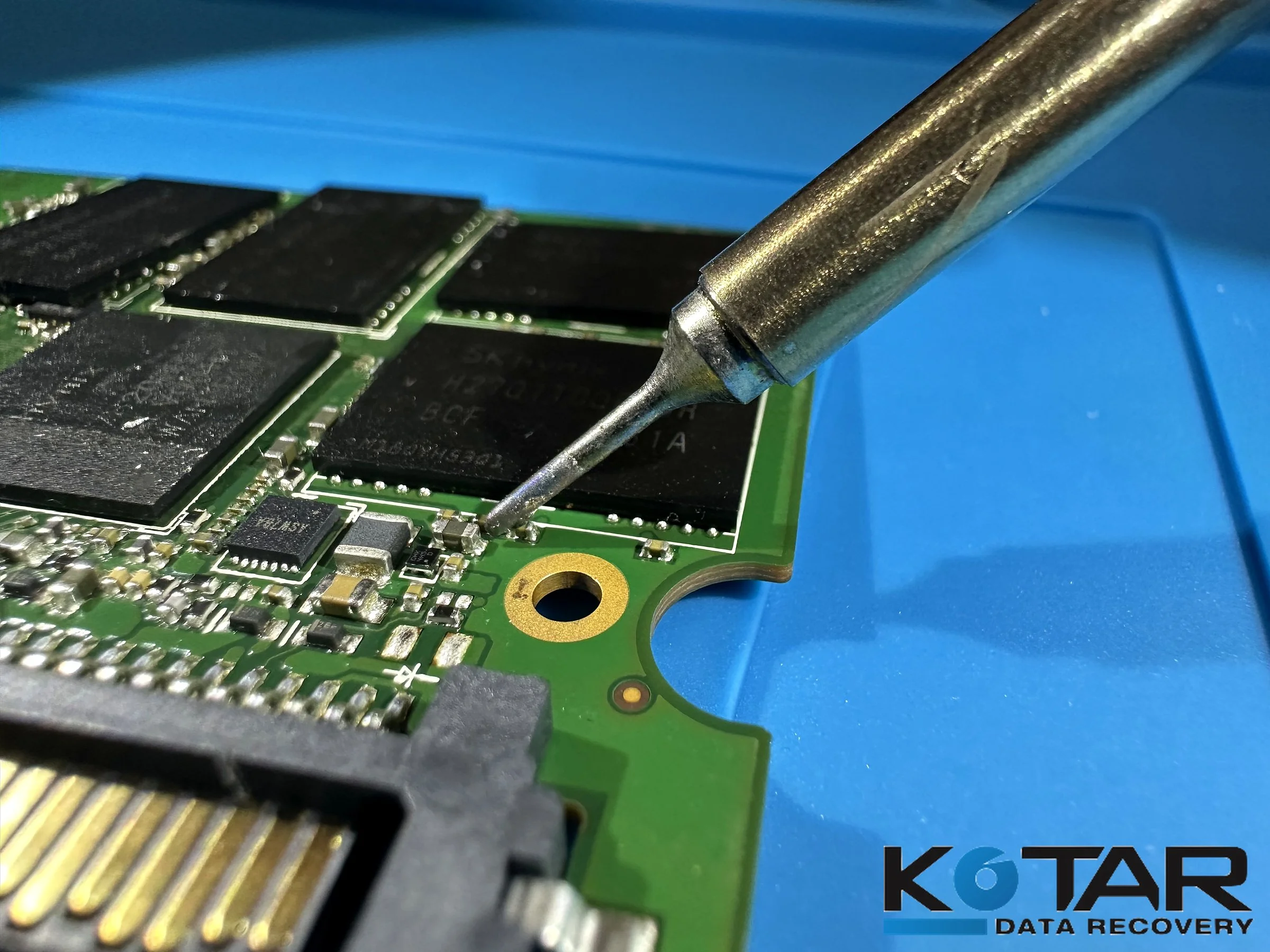
A precision soldering tool performs board-level microsoldering on an SSD circuit board beside its NAND flash memory components. This specialized work is performed in-house at Kotar Data Recovery’s San Jose lab when it is technically appropriate for the data recovery process.