
CCTV surveillance video recovery: can deleted or missing security footage be recovered?
October 14, 2026
Security camera footage often becomes important only after something has already happened.
A break-in. A vehicle accident. Theft. Property damage. A workplace incident. A dispute where the recording could help establish what actually occurred.
Then, at exactly the moment the footage is needed, the DVR or NVR stops working, the recording cannot be found, the hard drive becomes unreadable, or someone discovers that the video was deleted.
The good news is that missing surveillance footage is not always gone.
Depending on what happened to the recording and whether the storage space has already been overwritten, professional CCTV data recovery can sometimes recover video from DVRs, NVRs, surveillance hard drives, SD and microSD cards, and other security camera storage devices.
why CCTV footage disappears.
Surveillance systems are designed very differently from ordinary computers.
A DVR or NVR may continuously record video from several cameras while automatically managing the available storage space. Many systems also use proprietary file systems, databases, video formats, or recording structures that are not recognized by ordinary computer software.
Security footage can become inaccessible for many reasons, including:
Accidental deletion
DVR or NVR failure
Failed or damaged surveillance hard drives
Corrupted file systems
Damaged recording databases or indexes
Power failures or improper shutdowns
Bad sectors on the storage drive
Failed storage initialization
Memory card corruption
Recorder hardware failure
Deleted camera recordings
Reformatted storage
Video that no longer appears in the recorder's playback interface
Surveillance systems that are no longer detected or will not boot
Sometimes the recording itself is still present even though the surveillance system can no longer locate or play it.
That distinction can be extremely important during recovery.
deleted CCTV footage may still exist on the storage device.
Deleting a surveillance recording does not necessarily mean every part of the video is immediately erased.
Depending on the surveillance system, deletion may remove references to the recording while portions of the underlying video data remain on the hard drive or memory card.
Professional recovery can go beyond simply searching for ordinary video files.
Surveillance systems often store recordings in proprietary structures rather than as familiar MP4 or AVI files. Recovery may therefore require analyzing the underlying recording data, identifying valid video streams, reconstructing individual frames, and rebuilding those frames into playable recordings.
This becomes particularly important when the normal directory, database, or playback information has been damaged or deleted.
the biggest danger is overwritten footage.
CCTV systems commonly reuse storage.
When the recorder reaches its storage limit, older recordings may be overwritten automatically by newer footage. Once the portions of the drive containing the needed video have been overwritten, recovery becomes much more difficult and can eventually become impossible.
That is why the first actions after discovering missing surveillance footage matter.
If an important recording has disappeared, stop recording to the affected device.
Do not continue using the DVR, NVR, hard drive, or memory card if the missing footage is important. Every additional hour of recording can potentially overwrite video that might otherwise be recoverable.
Do not initialize, format, reset, rebuild, or repair the storage device simply because the surveillance system recommends doing so.
Also avoid installing general-purpose recovery software directly on the original surveillance drive. CCTV storage often requires specialized analysis that is very different from recovering ordinary documents or photographs from a computer.
recovering footage from a failed DVR or NVR.
Sometimes the video was never intentionally deleted.
The problem is the recorder itself.
A DVR or NVR may suddenly stop recognizing its storage drive, display disk errors, fail to boot, or show no recordings even though cameras had been recording normally before the failure.
In these situations, the first step is determining whether the problem originates with the recorder, the storage media, the file system, or the surveillance recording structure.
If the surveillance hard drive has physical problems, professional hard drive data recovery may first require creating a controlled image of the drive so that the remaining readable sectors can be copied to stable storage.
Recovery work should then be performed from the image or clone rather than repeatedly stressing the original failing drive.
Once the storage is stabilized, the surveillance data can be analyzed and the recording structure reconstructed.
CCTV video recovery is different from ordinary file recovery.
Surveillance recordings are often fragmented, continuously written, and stored in manufacturer-specific formats.
A typical DVR or NVR can contain recordings from multiple cameras along with timestamps, indexes, databases, event information, and other system data.
If those structures are damaged, simply searching the disk for conventional video files may produce incomplete recordings or no usable result at all.
Specialized CCTV recovery can analyze the underlying video streams and identify individual valid video frames even when the original surveillance file structure is damaged.
The associated frames can then be reconstructed into continuous playable recordings.
When appropriate, recovered video can be exported into standard video containers such as AVI so that it can be opened using commonly available video players.
The original video content is not altered during reconstruction. Preserving the source data and working from controlled copies whenever the condition of the device allows it is especially important when surveillance footage could later be needed for insurance, legal, investigative, or evidentiary purposes.
what about timestamps and individual cameras?
One of the challenges with surveillance recovery is that customers usually do not need every recording on the device.
They may need:
One particular camera
A specific date
A narrow time period
Video immediately before or after an incident
Several cameras covering the same event
Where the surveillance system's recording structure and remaining metadata allow it, recovered footage can often be analyzed to help identify relevant recordings.
However, damaged databases, overwritten metadata, incorrect recorder clocks, or severely corrupted storage can affect the availability or accuracy of timestamps.
For that reason, knowing the approximate date, time, camera number, and incident location before recovery begins can be extremely helpful.
DVR, NVR, hard drive, and memory card recovery.
Surveillance video may be stored on several different types of media.
Our San Jose lab works with CCTV and security camera recordings stored on:
DVR systems
NVR systems
Internal surveillance hard drives
External hard drives
SSD storage
SD cards
microSD cards
Flash memory
Camera-based storage devices
For surveillance systems that record directly to SD cards, microSD cards, or other flash-based storage, specialized photo and flash memory recovery can be necessary when the media is corrupted, formatted, unreadable, or contains deleted recordings.
We also work with cases where the storage device is no longer detected, physically damaged, corrupted, accidentally formatted, or contains recordings that can no longer be accessed through the original surveillance system.
surveillance systems and manufacturers we work with.
Security camera systems vary significantly between manufacturers, and many use their own recording structures and video formats.
Kotar Data Recovery can work with recordings from many commonly used surveillance systems, including systems from:
ADT, AVTECH, Dahua, EverFocus, Hikvision, IDIS, LG, Lorex, Samsung, Siemens, UNIMO, and many other CCTV and video surveillance manufacturers.
Even if your recorder or camera brand is not listed, that does not mean recovery is unavailable. The condition of the storage media and the way the system recorded its video are generally more important than the brand name alone.
can overwritten security footage be recovered?
This is one of the most common questions in CCTV data recovery.
If a recording was deleted but its storage space has not yet been reused, recovery may still be possible.
If newer surveillance footage has already overwritten the same physical storage area, however, the overwritten portion of the original recording cannot simply be restored.
That is why continuing to operate a DVR or NVR after discovering missing footage can dramatically reduce the chances of recovery.
If important security footage has disappeared, stop using the recording device before additional video overwrites the data you need.
what to do if important surveillance footage is missing.
If your DVR, NVR, security camera, hard drive, or memory card contains important footage that you can no longer access:
Stop recording to the affected storage device.
Do not format or initialize the drive.
Do not reset the DVR or NVR.
Do not rebuild or repair the storage unless you already have a verified backup.
Do not repeatedly power on a hard drive that is clicking, disappearing, or showing signs of physical failure.
Write down the approximate date, time, camera number, and event you need.
Preserve the original recorder and storage device whenever the footage could have legal or evidentiary importance.
The sooner the original storage is protected from further writing, the better the opportunity to recover footage that still remains.
CCTV data recovery in San Jose and the San Francisco Bay Area.
Surveillance footage can contain information that cannot be recreated after the fact. If an important recording disappears, protecting the affected DVR, NVR, hard drive, or memory card from further recording is one of the most important first steps.
At Kotar Data Recovery, we recover surveillance video at our San Jose data recovery lab for businesses, homeowners, security professionals, property managers, attorneys, and other customers throughout Silicon Valley and the San Francisco Bay Area.
Our lab provides professional data recovery services for deleted, inaccessible, corrupted, and undetectable CCTV storage devices. Careful handling of the original media gives the remaining surveillance data the best opportunity for a successful recovery.
If the recording could be important for a legal matter, insurance claim, accident, theft, security incident, or business investigation, stop using the recorder as soon as possible and preserve the original storage device.
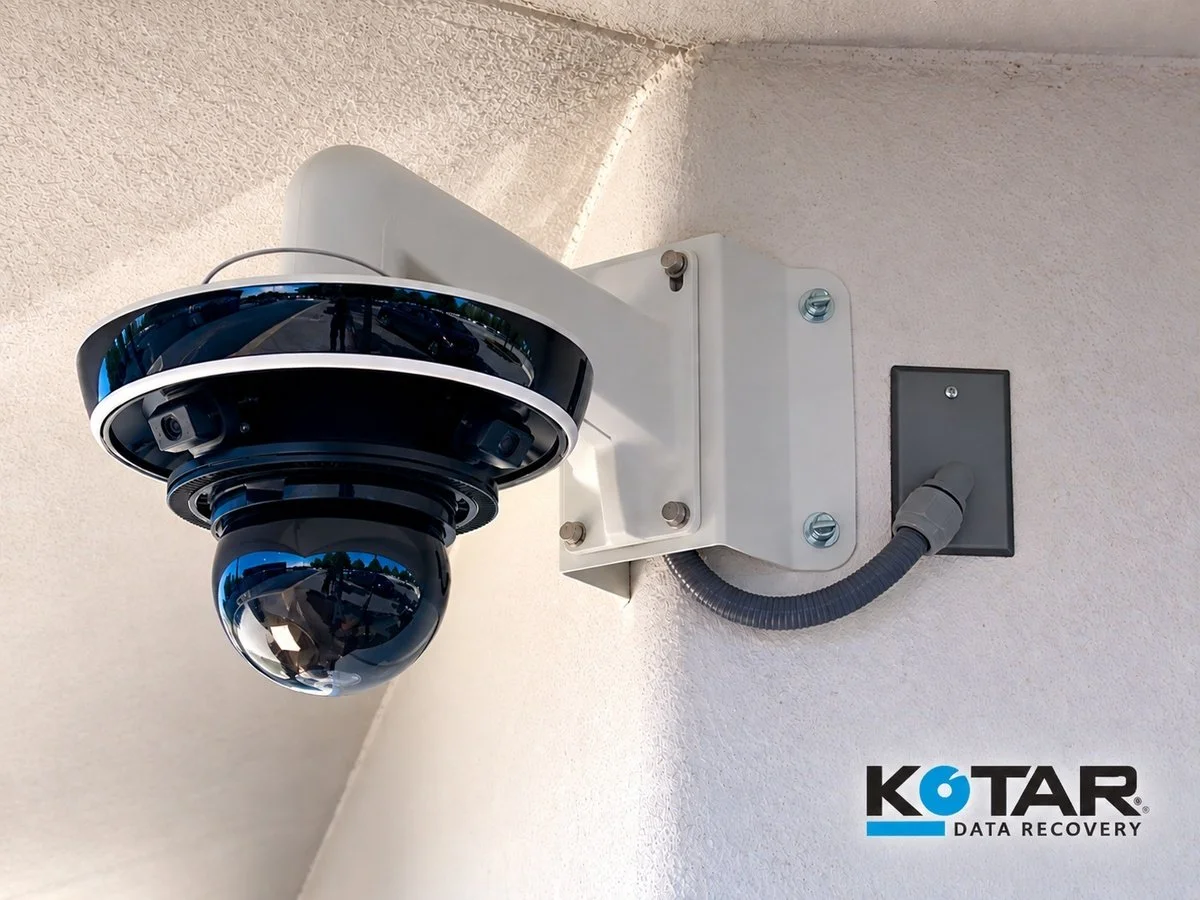
CCTV security camera for surveillance video and DVR data recovery